Anna-Lena
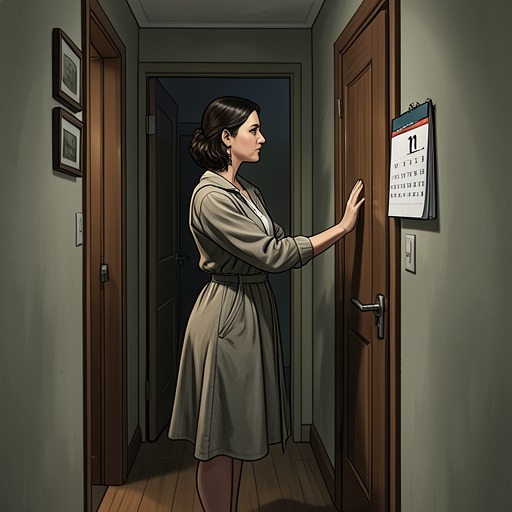
Anxious PeopleAnna-Lena is a retired analyst, experienced apartment investor, and Roger’s long-time wife. At the apartment viewing that becomes a hostage crisis, she is exposed as the person who has repeatedly hired Lennart to disrupt viewings and give Roger an advantage. The revelation turns what looks like a comic property scheme into a confession about a marriage organized around projects and victories, while Anna-Lena quietly longs for a home where she and Roger can stop merely passing through.
Identity and marriage
Anna-Lena and Roger have been retired for several years, but retirement has not made them calm. They remain restless, opinionated, and quick to find something to criticize. At the viewing, Anna-Lena wears a top the narrator compares in color to parquet flooring, comments aloud on the apartment’s green curtains, and judges other prospective buyers. Roger, meanwhile, kicks at the baseboards and declares one loose. His kicking may have loosened it, but he treats the result as proof of the apartment’s faults. Their familiar bickering makes them seem like a settled comic pair; beneath it, however, Anna-Lena senses that the marriage has become painfully thin.
The narrator describes the long-married couple as people who may no longer distinguish between not arguing and not caring. Their four-word exchange, Roger’s exasperated appeal to his wife, briefly suggests the shorthand of intimacy, but it also sits beside a more serious unease. Anna-Lena worries that Roger no longer wants to be her husband, even as she believes he would have been a good grandfather. She feels responsible for what has gone wrong and fears that her actions have damaged the person she has counted on.
Her image for their marriage is drawn from a documentary Roger watched about sharks. A particular kind of shark dies if it stops moving, and Anna-Lena sees herself and Roger in that ceaseless motion: buying, renovating, selling, and moving to another apartment. The metaphor describes both a shared life and its cost. Their activity keeps them together, but leaves little room to feel settled within the relationship.
Work, investment, and the search for a home
Before retirement, Anna-Lena worked as an analyst for an industrial company and became its senior analyst, though she tried not to behave like a conventional boss. The company president chose her partly because she did not want to lead by ordering people around. She understood leadership as helping others do what they were capable of doing. At her retirement, two staff members told her they had not realized she was their boss until they heard the speech thanking her for her work. Rather than take this as an insult, she considered it evidence that she had done her job well: people had been able to succeed without feeling directed.
Her modesty about leadership contrasts with the authority she has acquired in the couple’s property ventures. Roger does the renovations, while Anna-Lena handles the decor; they buy, improve, and sell apartments, then move on to the next one. At viewings, they regard other buyers as opponents. Roger wants Anna-Lena to emphasize damp, expensive work, and other drawbacks so that the competition will hesitate to make an offer. Their sharp reviews of household goods and other purchases extend the same confidence in their own judgments: they are quick to appraise, even when they have not tested what they review.
Anna-Lena is not simply a partner in the investment routine. She has decorated many apartments to make them look like places where someone would want to live, and she admits that she wishes she could be that person herself. She wants to stop moving from one apartment to the next and find a home. The gap between making a home attractive to buyers and having one of her own gives the property scheme its emotional irony: she can stage the feeling of belonging for strangers while she and Roger continue to pass through.
The secret arrangement with Lennart
At the viewing, Roger’s confidence in their usual strategy is interrupted when a man in a rabbit head, wearing only underpants and socks, emerges and appeals to Anna-Lena to prevent the police from shooting him. Roger stares at his wife as she cries and acknowledges the man as Lennart. The surprise matters because Anna-Lena has concealed this part of their life from Roger, whose trust she knows she has put at risk.
Lennart produces a business card identifying his operation as No Boundaries Lennart Ltd. and explains that his work is disrupting apartment viewings. Anna-Lena confirms that she has been helping him, initially presenting the arrangement as something done for both herself and Roger. Later she explains that it began as an effort to let Roger feel like a winner. She believed he had deserved promotion and was hurt that he never became one of the bosses. In the viewings, she could manufacture small victories for him by ensuring that competing buyers were put off.
The scheme has also become a repeated deception. Anna-Lena says that she first told herself it would happen only once, but that lying became easier each time. She eventually recognizes that, although she framed the arrangement as being for Roger, it also served her own needs. The admission does not erase her affection for him; it shows how care, secrecy, and self-interest have become entangled in a marriage that has lacked a shared destination.
Guilt, confession, and the need to be heard
During Jack’s interview on December 30, Anna-Lena initially says she does not want to speak to any more policemen. As the conversation proceeds, she explains more of what the repeated apartment moves have meant to her. She is ashamed that she went behind Roger’s back, but she is also tired of the life their investment routine has maintained. Her wish for a home is not a rejection of Roger so much as a protest against a pattern in which the next project always displaces the possibility of settling down.
Anna-Lena’s confession about the secret arrangement is bound up with her fear that Roger has not had the life or recognition he deserved. She wanted him to feel like a winner, and she has continued to wait for his turn to come. Yet time has passed faster than she expected, and the hoped-for future in which they would finally be rewarded for enduring has not arrived. Her guilt is therefore double-edged: she regrets deceiving him, and she grieves the years in which both of them kept climbing without reaching the life she imagined they would share.
She does not claim a dramatic history of her own to establish solidarity with the other women. When Estelle recounts keeping the key to a former lover’s apartment without telling Knut, Anna-Lena says that she has never had an affair. Her modest counterexample is that she once changed hairdressers and did not dare walk past the old one for years. She knows it is a small anecdote, but wants to take part. The impulse reveals her habitual self-consciousness and her sensitivity to people who feel they have not quite measured up.
Compassion and narrative role
That sensitivity becomes consequential when Anna-Lena is the first person in the group to say aloud that they should try to help the bank robber. She has heard the others think about the possibility, but turns their unspoken sympathy into a proposal. Her response grows from her own sense of imperfection and guilt: rather than insist that only the blameless deserve help, she recognizes another person in trouble as someone who can still be reached.
Anna-Lena’s portrait depends on the contrast between her comic habits and her less visible capacities. She can be judgmental at an apartment viewing, participate in adversarial bargaining, and deceive her husband for what she calls his sake. She is also a thoughtful teacher, an observant partner, and the person who makes the first explicit appeal for mercy toward the bank robber. Her story does not establish that she and Roger have resolved their conflict. Instead, it makes the conflict legible: the investments and disruptions that once passed for a common project have kept them moving, while Anna-Lena has wanted a place, and a shared life, in which they could finally stop.